Three generations of knowing what your system is doing
In 2010, “monitoring” meant a Nagios check that told you whether a server was up or down. In 2016, it meant Splunk dashboards aggregating logs from a hundred microservices. In 2026, it means an AI-assisted observability platform that identifies anomalies before they become incidents, correlates signals across the full stack in seconds, and tells your engineers not just what is broken but why — with confidence.
I’ve lived through all three of these generations as both a practitioner and a delivery executive. Each transition looked optional at the time and mandatory in hindsight. The shift to AI-native observability is the same.
This article traces that journey and shows you what a modern, AWS-native observability platform looks like — the architecture, the tooling, and the cultural shift required to make it work.
Generation 1: Metrics and alerts (2008–2015)
The first generation of cloud monitoring was borrowed directly from on-premises operations. You had a server. You watched its CPU, memory, disk, and network. When a threshold was breached, a pager fired. The assumption was that infrastructure was the system — if the infrastructure looked healthy, the system was healthy.
On AWS, this era was represented by CloudWatch in its original form: basic EC2 metrics, simple threshold alarms, and SNS notifications. It was better than nothing. It told you when your server was suffering. It told you nothing about whether your users were suffering.
The fundamental failure of generation 1 monitoring was the conflation of resource health with system health. You could have a perfectly healthy fleet of EC2 instances serving responses that were all wrong. Generation 1 would never know.
Generation 2: Logs, traces, and distributed observability (2015–2022)
The microservices revolution broke generation 1 monitoring completely. When a single user request touches twelve services across three availability zones, a CPU alarm on one EC2 instance means nothing. You needed to see the request, not the resource.
Generation 2 introduced the observability pillars framework: metrics, logs, and traces. Metrics for the what. Logs for the context. Traces for the where and the how long. AWS built out this generation steadily: CloudWatch Logs Insights brought SQL-like querying to your log data; X-Ray brought distributed tracing; CloudWatch Container Insights brought Kubernetes-native visibility.
Third-party tools matured alongside: Datadog, New Relic, Dynatrace, and Grafana all built deep AWS integrations. The generation 2 practitioner had more data than they’d ever had before.
And therein lay the new problem. Too much data. Teams were drowning in dashboards. The average CloudWatch console for a moderately complex AWS workload contains hundreds of metrics, dozens of log groups, and multiple service maps. A generation 2 observability team wasn’t overwhelmed by lack of information — they were overwhelmed by the cognitive load of interpreting it all in real time during an incident.
Generation 3: AI-driven observability on AWS (2022–present)
Generation 3 doesn’t give you more data. It gives you intelligence on top of the data you already have. The defining characteristic is the shift from engineers querying observability tools to observability tools surfacing insights to engineers.
Here is the full AWS-native Generation 3 observability stack, as we deploy it today.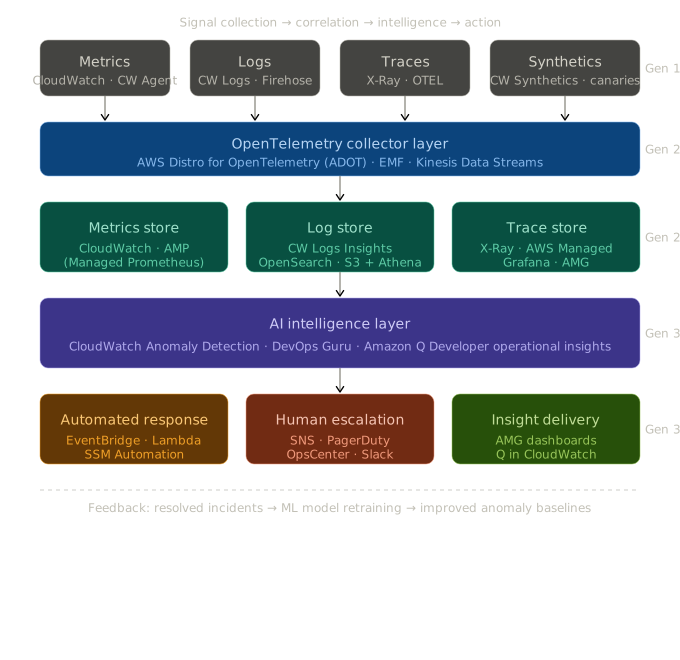 The architecture above makes explicit what most observability implementations leave implicit: there are three distinct functional layers, and most teams build the bottom two and skip the intelligence layer at the top.
CloudWatch Anomaly Detection: ML baselines without a data science team
CloudWatch Anomaly Detection applies machine learning to your existing CloudWatch metrics to establish dynamic baselines — learning the normal patterns of your system across time-of-day and day-of-week cycles, then surfacing deviations automatically.
The operational value is that you don’t need to know in advance what “normal” looks like for a metric. Traditional threshold alarms require you to say “alert me if error rate exceeds 1%”. Anomaly Detection learns that your error rate is normally 0.02% on Tuesday mornings and 0.08% on Monday evenings after batch runs, and alerts you when it deviates from its own pattern — not from an arbitrary fixed threshold.
For managed services operations, this changes the economics of alert tuning significantly. Fixed threshold alarms require constant calibration as workloads evolve. ML-based anomaly detection recalibrates itself. The operational burden shifts from “tune 200 alarms quarterly” to “review and validate anomaly model drift semi-annually.”
Amazon DevOps Guru: cross-service insight correlation
DevOps Guru is the AWS service that most directly embodies the generation 3 observability promise. It continuously analyses your CloudWatch metrics, CloudWatch Logs, CloudTrail events, and X-Ray trace data — across all your services simultaneously — and uses ML to identify anomalous patterns that correlate across multiple signals before they produce an incident.
The practical power is in the correlations it surfaces that no engineer would catch manually. A recent example from a client engagement: DevOps Guru identified a pattern where an increase in Lambda cold starts was correlated with elevated SQS queue depth, which was correlated with a downstream RDS connection pool saturation — three separate signals in three separate AWS services that, individually, looked like noise but together indicated a capacity planning issue that would have caused a P1 incident six hours later. No alarm was firing. No dashboard showed red. DevOps Guru flagged it as an anomaly insight and recommended a specific remediation.
That is what generation 3 observability actually means in practice.
Amazon Q Developer in CloudWatch: conversational operations
The most recent evolution in AWS observability is the integration of Amazon Q Developer directly into the CloudWatch console. Engineers can now query their observability data in natural language — “show me the services that had the highest error rate increase in the last 4 hours and correlate with recent deployments” — and receive synthesised answers that pull from metrics, logs, and traces simultaneously.
For on-call engineers at 2 AM, this changes the cognitive experience of incident response fundamentally. The shift from “manually construct Logs Insights queries across multiple log groups while simultaneously checking X-Ray traces and CloudWatch dashboards” to “ask a question and get a synthesised answer with supporting evidence” reduces mean time to diagnosis by a measurable margin. In our managed services practice, we’ve observed MTTD reductions of 40–60% for complex multi-service incidents after deploying the full generation 3 stack.
OpenTelemetry and the vendor-agnostic signal layer
One architectural decision that carries significant long-term value is investing in the OpenTelemetry (OTel) standard for signal collection. AWS Distro for OpenTelemetry (ADOT) gives you a vendor-neutral, standardised instrumentation layer that sends data to CloudWatch, X-Ray, or any other backend simultaneously.
The strategic value: you’re not locked into the CloudWatch data model for all your observability data. Your OTel-instrumented applications can send the same signals to Amazon Managed Grafana for visualisation, to OpenSearch for log analytics, to Amazon Managed Service for Prometheus for Prometheus-compatible metric storage, and to AWS X-Ray for traces — all simultaneously. Your instrumentation code doesn’t change when you add a new observability backend. This matters when clients have regulatory requirements for long-term log retention in specific storage systems, or when you’re operating a multi-cloud estate where some signals originate outside AWS.
The culture change that makes observability work
The technology stack described above is necessary but not sufficient. Observability only delivers value when your engineering culture treats it as a first-class engineering discipline rather than an operational afterthought.
The specific cultural shift required has three components. First, observability must be defined at design time, not added post-deployment. Every service design review must answer: what are the SLIs for this service, and how will they be instrumented? Services that don’t answer this question don’t pass design review.
Second, dashboards must have owners. A dashboard that nobody owns degrades into noise within six months as the system evolves and the dashboard doesn’t. Every CloudWatch dashboard in our managed services practice has a named owner who is responsible for its accuracy.
Third, on-call engineers must be empowered to improve observability. When an on-call engineer solves an incident and thinks “I wouldn’t have had to spend 45 minutes debugging if we’d had this alarm in place,” they file a ticket to add that alarm before they close the incident. The observability system is a living system, not a one-time configuration exercise.
Observability 3.0 is not a tool. It’s a practice. AWS provides the best-in-class tooling to support it. But the practice is yours to build.