Security Agent is the newest layer, not the only one. This article covers the AWS-native services an MSP still needs underneath it, and how to price the whole stack by client tier.
A single agent, however capable, is not a security practice — it is a layer. AWS Security Agent covers the application layer: design, code, and runtime exploitability. Everything below that — account posture, network perimeter, and cross-account threat correlation — still runs on the AWS-native security services that predate the agentic wave and remain the actual foundation an MSP builds on.
1. The Three Layers Below the Agent
Perimeter. AWS WAF now sits in front of Amazon Bedrock AgentCore Gateway, which matters the moment your own practice starts running agent workloads on behalf of clients — the agent’s tool-calling interface is itself a surface that needs the same perimeter controls as any public endpoint.
Detection and posture. GuardDuty for continuous threat detection across accounts, workloads, and EKS runtime; Security Hub aggregating findings into one view; Security Lake normalizing that data into OCSF format for long-term correlation and, increasingly, for feeding third-party detection signals (Check Point, Zscaler, Rubrik, Netskope, and SentinelOne integrations were added to AgentCore-adjacent workflows in 2026); Config and IAM Access Analyzer for continuous posture and least-privilege drift detection.
Application. Security Agent, covered in depth in Article 1, sitting atop all of the above.
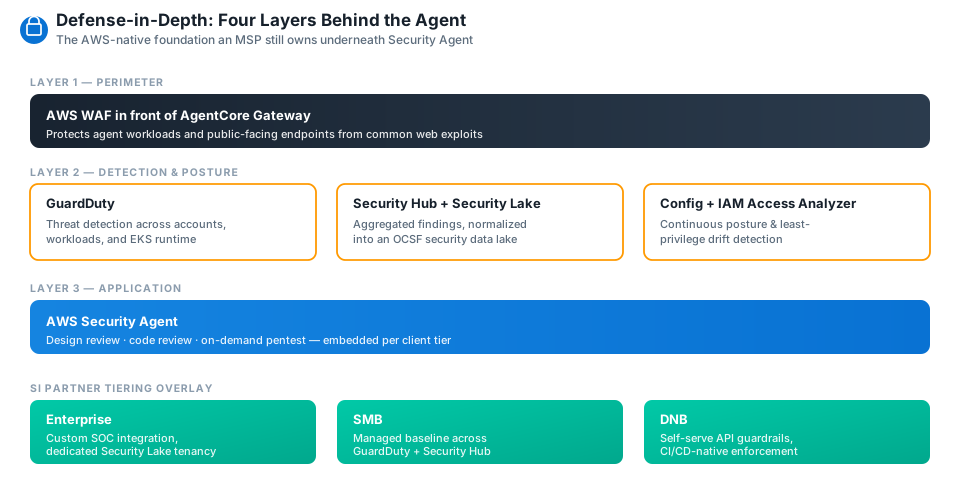 Figure 2. Four layers, one architecture — the SI partner’s actual deliverable.
2. Why the Layering Matters Commercially
Selling Security Agent alone invites an obvious client question: what happens to an attacker who never touches the application layer at all — a leaked credential, a misconfigured S3 bucket, a compromised third-party integration? The honest answer is that Security Agent does not see any of that; it is scoped to application security. An MSP that sells only the agent is selling a partial answer to a full-estate problem, and a technically literate buyer will notice.
The correct commercial framing is the full stack: perimeter, detection, posture, and application, packaged as one managed offering with Security Agent as the newest and most visible component — not the whole product.
3. Tiering the Practice
Enterprise — custom SOC integration: Security Lake feeding the client’s existing SIEM or a dedicated tenancy, GuardDuty and Security Hub findings correlated against Security Agent’s application-layer findings for a single incident timeline.
SMB — a managed baseline across GuardDuty, Security Hub, and Config, with Security Agent’s managed-cadence tier from Article 1 layered on top. This is the volume tier: standardized, not customized.
DNB — self-serve API-first guardrails: Config rules and IAM Access Analyzer findings exposed via API for the client’s own platform team to consume, with the partner’s value concentrated in guardrail design and quarterly review rather than day-to-day operation.
What changes for the SI partner
The pitch stops being “we run your SOC” and becomes “we run the four-layer stack, and the layer you can see — Security Agent’s pentest reports and remediation PRs — is backed by three layers you don’t have to think about.” That framing sells the agent and the foundation as one motion instead of two separate line items competing for the same budget line.
Business Value Mapping
| Technical capability | Business outcome | Metric / KPI | Primary stakeholder |
|---|---|---|---|
| WAF in front of AgentCore Gateway | Agent tool-calling surface does not become an unguarded attack vector | Blocked malicious requests per month | CISO |
| GuardDuty + Security Hub + Security Lake correlation | One incident timeline instead of four disconnected consoles | Mean time-to-correlate an incident | SOC lead |
| Config + IAM Access Analyzer continuous posture checks | Drift caught before it becomes an exploitable gap | Days of posture drift before remediation | Cloud security architect |
| Application-layer findings tagged to shared resource identity | Cross-layer correlation instead of siloed alerts | % of incidents correlated across >1 layer | CISO |
| Four-layer stack sold as one managed offering | Single retainer replaces multiple point-tool contracts | Net revenue per client vs. point-solution pricing | Partner CRO / sales |
An agent is a capability. A defense-in-depth architecture is what a client is actually buying when they sign a security retainer.
Sources: AWS Security Agent GA (AWS What’s New, March 2026) · AWS WAF adds support for Amazon Bedrock AgentCore Gateway (AWS What’s New, June 2026) · Amazon Bedrock AgentCore Policy and third-party detection integrations (AWS re:Invent 2025 announcements)