AWS’s newest frontier agent is also its most conservative one by design. That restraint is the actual selling point for regulated Enterprise clients.
AWS FinOps Agent entered preview in June 2026, built on Amazon Bedrock, aimed squarely at a problem every FinOps practice knows well: cost anomalies get discovered days after they start, by which point the wasted spend is already booked. The agent’s job is to compress that discovery window from days to hours — without, notably, taking any autonomous action on spend itself.
1. What It Does
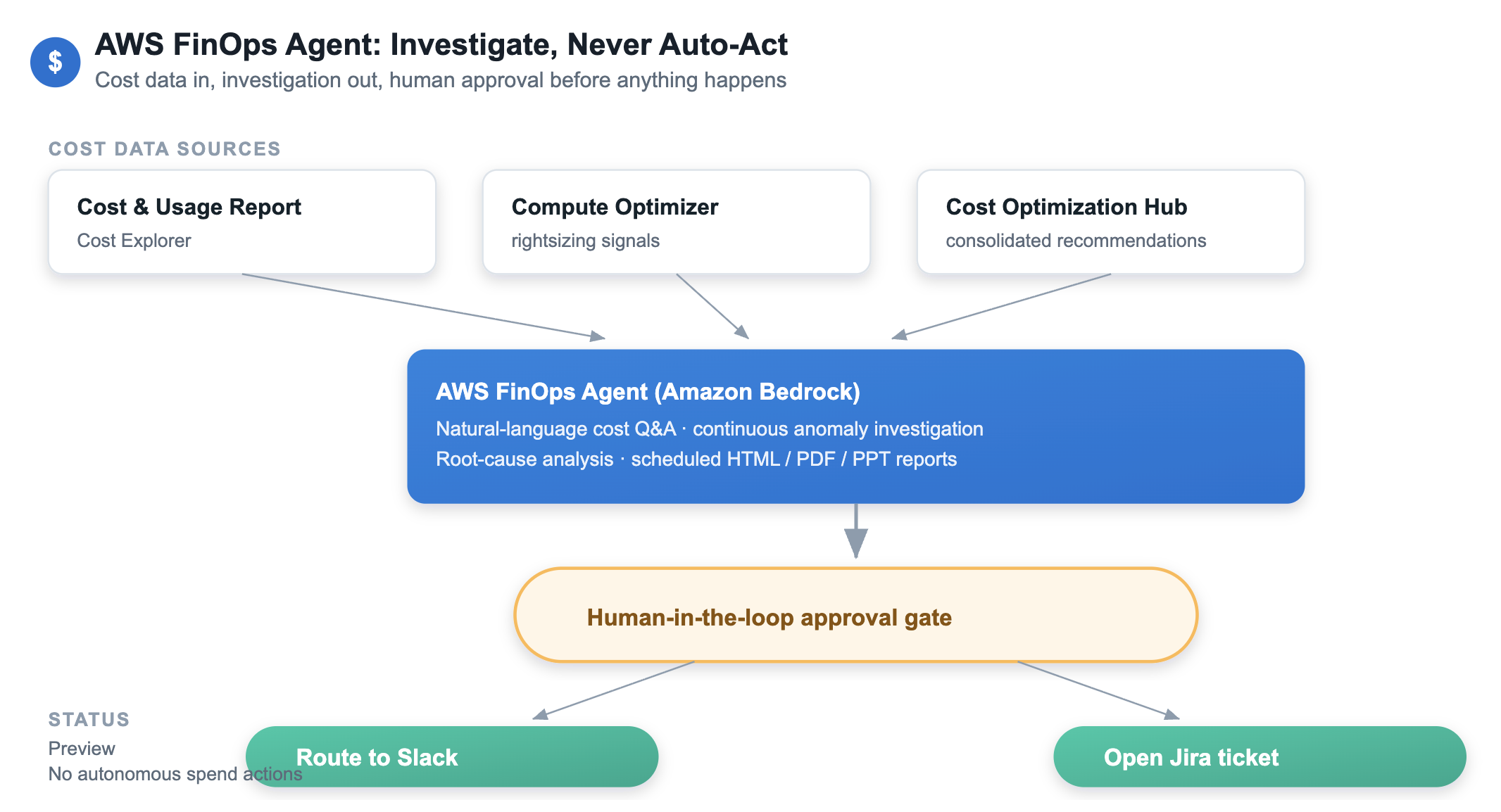
FinOps Agent answers cost questions in natural language against a customer’s actual cost and usage data, continuously monitors for anomalies, and — the part that differentiates it from a dashboard — automatically investigates and reports on anomalies without waiting for a human to start digging. It surfaces optimization recommendations by pulling from Cost Optimization Hub and Compute Optimizer into one place, with the option to open a Jira ticket automatically when it finds something actionable. Findings and recurring reports land in Slack and Jira — where FinOps and engineering teams already work, not in a console tab someone has to remember to check.
2. The Deliberate Design Constraint
Unlike DevOps Agent, which can act on reversible infrastructure changes, FinOps Agent is intentionally built with a human in the loop for every finding — it does not autonomously terminate resources, cancel commitments, or resize infrastructure. AWS’s own framing is explicit: autonomous cost actions require a level of trust the industry is still building toward. That is a product decision, not a current limitation waiting to be lifted quietly — and it is worth stating plainly to clients, because the alternative framing (“an AI agent that can touch your production spend on its own”) is the one that kills deals with a cautious CFO.
3. Productizing the Practice
Enterprise — FinOps Agent wired into the client’s existing multi-account cost allocation structure, findings routed to a dedicated FinOps Slack channel, monthly board-ready reports generated in PPT format automatically. The human-in-the-loop design is the actual pitch here: it lets a regulated client adopt agentic cost governance without a governance committee fight over autonomous spend control.
SMB — a standard configuration against Cost Explorer and Compute Optimizer, recurring PDF reports on a monthly cadence, sold as a fixed-fee FinOps subscription layered on top of the landing zone.
DNB — Slack-native, engineering-team-facing: anomaly alerts and Jira tickets flow directly into the same channels the engineering team already lives in, with the MSP’s role limited to initial configuration and quarterly tuning rather than ongoing report delivery.
What changes for the SI partner
Traditional FinOps engagements sell a monthly or quarterly cost review meeting. This sells continuous investigation with human sign-off — the review meeting becomes a checkpoint on findings the agent already surfaced, not the moment discovery happens. That shortens the sales cycle for renewal, because the value is visible in Slack every week instead of once a quarter in a slide deck.
Business Value Mapping
| Technical capability | Business outcome | Metric / KPI | Primary stakeholder |
|---|---|---|---|
| Continuous, baseline-tuned anomaly detection | Cost spikes caught in hours, not discovered days later at month-end close | Days from anomaly onset to detection | FinOps lead |
| Automatic root-cause attribution | No manual digging through CUR data to find the driver | Time from alert to identified cause | Cloud engineering |
| Human-in-the-loop approval on every finding | Governance-committee-safe adoption for regulated clients | Zero autonomous spend actions (compliance requirement) | CFO / risk committee |
| Slack- and Jira-native findings routing | Findings surface where teams already work, not in an ignored console | Finding-to-acknowledgment time | Engineering manager |
| Automated board-ready PPT/PDF reports | Recurring FinOps review prep time eliminated | Hours saved per reporting cycle | CFO / board |
The agent that refuses to act on its own is not the weaker product. For the client who has to explain every dollar to a board, it’s the only one they’re allowed to buy.
Sources: AWS launches FinOps agent to bring AI cost governance to cloud spend (SiliconANGLE, June 2026) · AWS FinOps Agent in preview (AWS Weekly Roundup, June 2026) · Introducing AWS FinOps Agent (DEV Community / AWS Builders) · AWS Previews FinOps Agent for Cost Analysis and Optimization (InfoQ, June 2026).