The other three agents in this series operate software after it ships. Kiro is AWS’s bet on the agent that builds it in the first place — and the one most likely to change an SI partner’s delivery economics.
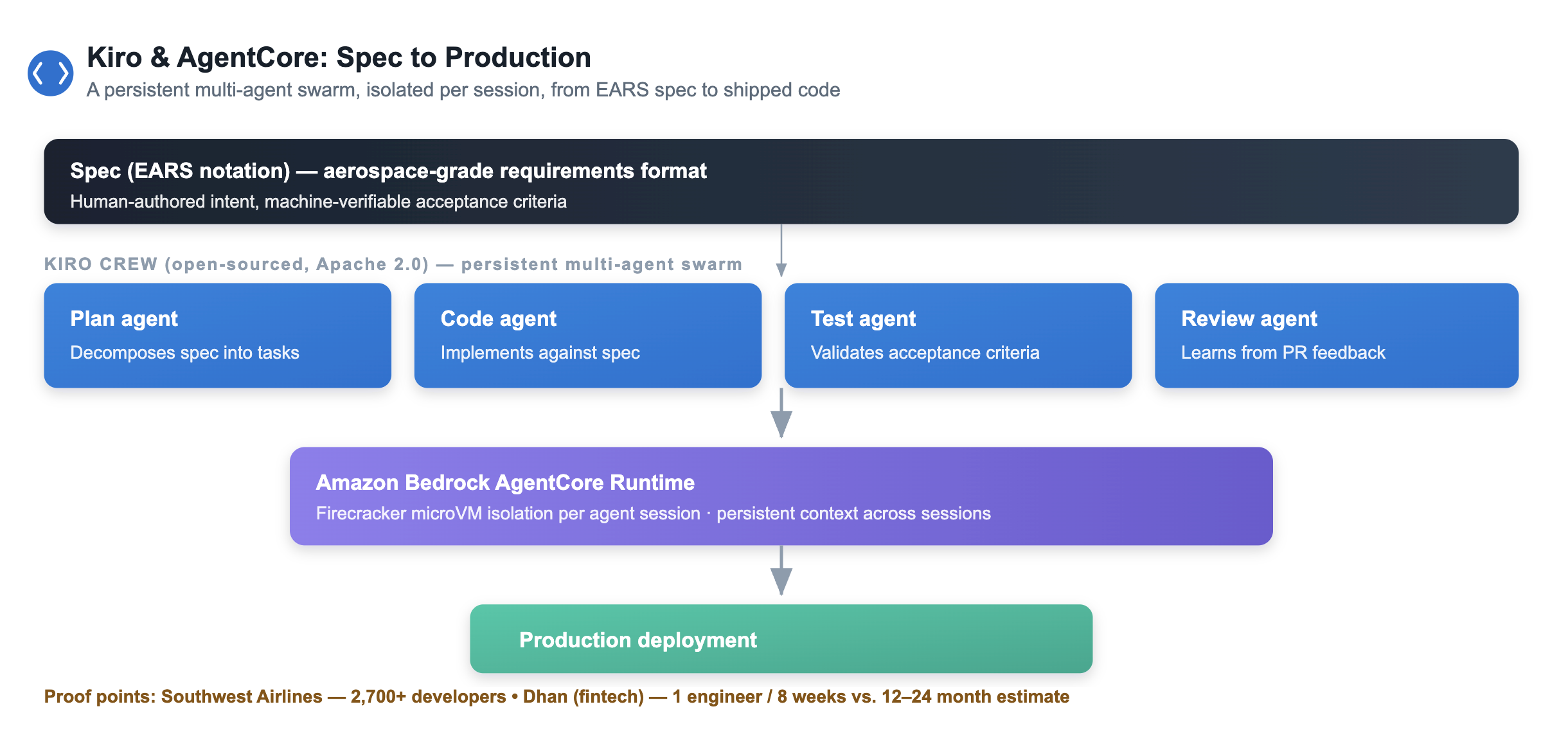
Kiro is AWS’s autonomous coding agent, and in August 2026 AWS open-sourced its multi-agent orchestration layer, Kiro Crew, under Apache 2.0 — while keeping the underlying agent harness itself proprietary. That split matters for a partner deciding how deeply to build on it: the orchestration pattern is inspectable and forkable, the execution engine is not.
1. Spec-Driven Development
Kiro’s development model starts from a specification written in EARS notation — Easy Approach to Requirements Syntax, a format borrowed from aerospace-grade requirements engineering, chosen specifically because it produces requirements that are both human-readable and machine-verifiable. That spec is what Kiro Crew’s agents decompose into implementation tasks, rather than working from a loose natural-language prompt — the discipline that separates a coding agent producing production-ready output from one producing plausible-looking output that fails on the edge cases nobody specified.
Kiro maintains persistent context across sessions and continuously incorporates feedback from pull requests, which means the second feature built against a codebase benefits from what the agent learned reviewing the first one’s PR comments — a compounding effect that a stateless code-generation tool doesn’t get.
WHEN a customer submits a checkout request
WHILE their cart total exceeds the fraud-review threshold
THE SYSTEM SHALL route the order to manual review
  AND SHALL respond within 200ms with a "pending review" status.
Kiro Crew’s Plan agent decomposes that single requirement into implementation tasks; the Test agent derives acceptance tests directly from the WHEN/WHILE/SHALL clauses, so a test failure traces back to a specific clause rather than a vague “feature broken” report. This is the mechanism, not just the philosophy, behind why spec-driven development produces fewer edge-case regressions than prompting an agent with a paragraph of prose — the requirement format itself eliminates an entire class of ambiguity before generation starts.
2. The AgentCore Foundation
Kiro Crew’s agents execute on Amazon Bedrock AgentCore Runtime, with each session isolated in its own Firecracker microVM — the same isolation primitive covered in Article 1’s Security Agent breakdown. That is not incidental: it is what allows an SI partner to run Kiro Crew across multiple client codebases on shared infrastructure without one client’s agent session having any path to another’s code or credentials.
The enterprise adoption numbers are worth citing directly because they’re unusually concrete for this category: more than 2,700 Southwest Airlines developers use Kiro to build features, automate testing, and generate infrastructure for modernizing Southwest.com; Dhan, an Indian fintech, built a new charting platform with a single engineer in eight weeks against an original estimate of a dozen people over twelve to twenty-four months.
3. Productizing the Practice
This is the article in the series most likely to threaten an SI partner’s existing revenue model before it becomes an opportunity, so it’s worth naming that directly: a development shop billing time-and-materials for feature delivery is competing against a client’s own team using Kiro directly. The defensible position is not “we also have Kiro” — it’s packaging spec-writing discipline, AgentCore governance, and production-readiness review as the service, with Kiro Crew as the execution layer underneath.
Enterprise — an “Agent Factory” practice: the partner owns spec authoring (translating business requirements into EARS notation), Kiro Crew execution, and a human review gate before merge, sold as a fixed-fee delivery model per feature rather than per developer-hour.
SMB — a lighter version: the partner trains the client’s own small team on spec-driven development with Kiro, then steps back into an advisory/review role.
DNB — often self-service already; the partner’s role is narrow and high-value: AgentCore governance, multi-tenant isolation review, and production-readiness gates for a team that’s already using Kiro directly and needs the guardrails, not the development.
What changes for the SI partner
Billing shifts from developer-hours to fixed-fee-per-feature, because the marginal cost of generating the code has collapsed and the marginal cost of specifying it correctly and reviewing it for production-readiness has not. Partners who keep selling developer-hour blocks against a client who can generate the same code with Kiro directly are pricing against their own replacement.
Business Value Mapping
| Technical capability | Business outcome | Metric / KPI | Primary stakeholder |
|---|---|---|---|
| EARS-notation spec-driven development | Requirements ambiguity eliminated before code generation starts | Edge-case regression rate post-launch | Engineering lead / QA |
| Persistent multi-agent swarm (Plan/Code/Test/Review) | Feature delivery in weeks instead of months | Time from spec to production deployment | CTO / product |
| Firecracker microVM isolation per session | Multi-client codebases run safely on shared partner infrastructure | Cross-tenant isolation audit pass rate | CISO |
| Persistent context + PR-feedback learning | Second and third features benefit from what the agent learned on the first | Reviewer comment volume trend over time | Engineering manager |
| Fixed-fee-per-feature delivery model | Partner margin decoupled from developer headcount | Gross margin per delivered feature | Partner CFO |
The scarce skill was never typing code. It was writing a specification precise enough that an agent — or a junior developer — could not misread it. That skill just became the entire business.
Sources: AWS unveils frontier agents (About Amazon, re:Invent 2025) · AWS Open Sources Kiro Crew But Keeps The Agent Harness Closed (Forbes, August 2026) · Kiro Powers for autonomous AI agents on AWS (PwC) · AWS Summit New York 2026: New ways to make AI agents more effective at work (About Amazon).